When it comes to persistence, few things compare to a child that really wants something and tries to get it through nagging & negotiating. And few people know that better than a parent who has given that child an answer they don’t want to hear.
From the famed “Are we there yet?” to this morning’s “Can I have ice cream for breakfast?” to this afternoon’s “Can I have ice cream for dinner?” kids are notorious for their one-track minds, and they will ask…and ask…and ask…just in case you’ve changed your mind in the last minute.
This is a learned behavior that children of any age can pick up. They might continue to use it because once, in a moment of weakness, you caved and let them stay up an extra half hour after they asked for the eighth time.
But like any learned behavior, it can be unlearned. The solution comes from Lynn Lott, co-author of the Positive Discipline series of books, and it works on kids as young as two or three, all the way through their teens.
It only takes three simple words: “Asked and Answered.”
The concept is simple. When seven-year-old Daniel begs to dig a giant hole in the front yard and gets “no” for an answer, chances are he’ll be back in five minutes asking again – this time with a “pleeeeeeaase” just so you know he really, really wants to dig the hole.
Instead of repeating yourself or jumping in to a lecture, get eye to eye and follow the process below:
Step One: Ask, “Have you ever heard of ‘Asked and Answered’?” (He’ll probably say no.)
Step Two: Ask, “Did you ask me a question about digging a hole?” (He’ll say yes.)
Step Three: Ask, “Did I answer it?” (He’ll probably say, “Yes, but, I really ….”)
Step Four: Ask, “Do I look like the kind of mom/dad/teacher who will change her/his mind if you ask me the same thing over and over?” (Chances are Daniel will walk away, maybe with a frustrated grunt, and engage in something else.)
Step Five: If Daniel asks again, simply say, “Asked and Answered.” (No other words are necessary!) Once this technique has been established, these are the only words you should need to say to address nagging questions.
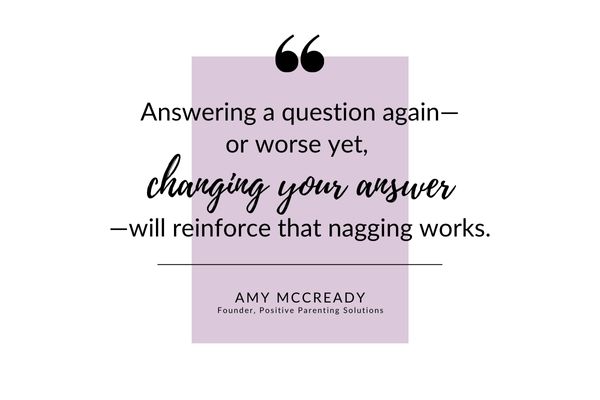
Consistency is key! Once you decide to use “Asked and Answered” with your questioning child, be sure to stick to it. If 14-year-old Emma is particularly determined to keep asking to get her eyebrow pierced, stay strong. Answering her question again – or worse yet, changing your answer – will reinforce to her that her nagging works. Although it’ll take some patience, your child will eventually connect the dots and you’ll see results!
Make “Asked and Answered” a joint effort with your spouse, and consider including any family or friends who may be getting the third degree from your child. When Daniel and Emma realize that they won’t get a “yes,” even after they’ve asked twelve times, they’ll get the hint and retire this tactic.
Speech and Language Pathologist, Stacy Pulley reports this technique works well for children with communication challenges, particularly those with Autism. She suggests bringing a notebook or a chalk/dry erase board into the mix and writing down a question once they’ve asked it more than once, keeping in mind their reading level. Or, draw a picture. Then, when your child asks again, point to the board or notebook to remind them that they’ve asked, and you’ve answered. Be sure to use as few words as possible and stay consistent in your language to help them understand the connection as they learn to listen to and respect your answers.
Adding this tool to your parenting toolbox is a positive step toward ending the nagging questions that can wear on even the most resolute of parents. Then, be sure to follow through and stay consistent – and before you know it, 20 questions will be a fun game once again, and no longer a negotiation tactic!
So, how can we help you?
About the Author


"Absolute


{ 174 comments… read them below or add one }
← Previous Comments
I’m going to be trying this out, I have a four year old that begs constantly and it grates on my nerves. Gonna give this a go!!
Salina, did it work for you?
I have 2 children that are always asking again and again after I say no. One is 9 and one is 6. Gonna give this a try!
Great! Let us know how it works for you Krista! Thank you!
I used the response “ask 3 Times and the answer is automatically NO”
It worked for my girls! This includes “can i stay over night at Amy’s” The 1st time something is asked is the legitimate ask. 2nd time was a reminder to me to think about it. I often set the kitchen timer to really think about it or call the parent to verify. After the timer went off I’d give my daughter my answer. But if she asked before the timer the answer ws NO. Good luck. I do like the asked and answered response.
I love this. But the question I have is what about when they ask “Why” they can’t do something, that they have asked for and I have answered “No.” That is where my frustration comes in. Because if I explain why, my 9 year old inevitably will come up with a counter argument. And I usually don’t have time for a debate. How do we handle the ‘Buuuuttttt WHHHHYYYYYYYY?”
Thanks so much
Try including a very simple answer to the “why” when you first answer the question to preempt the follow-up “why” from your child (Example:’No you can’t have a snack, because it’s too close to dinner.’) Then stick with the “Asked and Answered” routine. The why is just another tactic in trying to change your answer…
Thanks Momma O for asking!
My mom was the queen of shutting DOWN the “BUUUTTT WHHHYYYYYYYYY????” Her simple response, “Because I said so.” We usually couldn’t come up with a counter argument to THAT one … and even when we did I don’t think we dared to try it. The ‘because I said so’ was usually her way of saying, “I brought you into the world and I can take you out of it.”
Usually answer with a “because I’m mean”. My kids usually walk away…
Geowibg up my mom used this concept. She said EOD which stood for End of Discussion. I HATED it because I knew it was the end. She refused to even say anything else. I told myself I would never say that to my kids. Lol. I like the asked and answered. Same concept, different words.
Thanks for sharing Marie! It is vert similar concept. I guess some tools are just timeless!
I use something similar with my kids when they want to turn a conversation into a negotiation. I make sure to stop, look them directly in the eye and say, “I’ve said my peace.” I do feel that they need to be heard and keeping that line of communication somewhat open is important. In doing this, they know that I’ve heard them, but I am the parent and my decision is not only going to stand, it is also not going to change. This has grown with them and now, as 2 of my 3 children are teenagers, it is a respectful non-volitale way to conclude an issue. It is not always a satisfactory conclusion for all involved but the back and forth is done.
So true! Thanks Dawn for sharing!
One thing I’ve noticed in recent years is that most young mothers unwittingly allow their kids to negotiate by giving a command (“stop that now!” “Please clean up your toys”, “Stop whining”) and then they finish the command with “…OK?”…which to my way of thinking is giving the kid the option to say no…I don’t want to do it. I realize this may be slightly off topic, but it also ties in to the way one talks to children to get desired results (Asked and Answered) and stop finishing commands or behavior bribes with “…OK?”
Great point Linda!
Asking a child if something is okay is one of my pet peeves. It gives them the idea that the parent doesn’t have the final say. I was on a flight once that was actually late leaving because a mother and flight attendant were having trouble getting a child to leave her seat-belt buckled. They kept saying, “it’s just until after we get up in the air and then you can unbuckle it, okay?” The child kept saying “noooo,” and continued to scream. I sooo wanted to get up out of my seat and tell them I would handle it for them, lol. (I had the experience, I’m the mom of 7 extremely well-behaved kids.) We finally took off, accompanied to ear-splitting screams from both mother and child.
I love this and will give it a try. Currently, our system includes, “if you ask twice you must complete a chore” immediately. That has worked well. I then added, “if I have to ask you twice, complete a chore.”
So simple…Love it. Thanks for the fantastic idea.
You are welcome Sue! Thanks for commenting.
Amy this one really rocks!!!
Can I share on my Happy Parenting Community Page?
Regards
Judith-Rose Max
Share away Judith and thanks so much!
I love this approach. I think in a perfect world if I still had my cool
I would probably start off with “I hear that you want to…” before saying no the first time, to show empathy. Just pinned this!
Thanks Kelly!
Love this. Will give it a try. Thanks
This is a good idea. We must make sure we aren’t snarky about it though. The tone of our voice is important – calm and gentle but firm. It cannot be like ‘talk to the hand’. Sometimes I just say ‘I am not negotiating – I gave an answer. I am sorry you are disappointed. You can choose to be disappointed about this or you can be thankful for…. (some other opportunity or thing that is good)’.
I think this is great. However, the script as written here seems like it would work best for 4+ year olds. I am wondering how to best adapt it for a 2 year old that asks for things relentlessly. Thanks!
I would like to use this for “yes” answers as well! My little guy keeps asking me even after I’ve said “yes” as if he needs to remind me. I tell him after the third or fourth time that if he asks again, my asnwer is changing. I don’t like that. I’d rather have this simple tool and remember to use it!
Yes! Finally the soulution is here! Hope this works!
This goes a step too far IMO. With my daughter, from the time she could understand me, I did something very simple. If she asked for something, or to do something, I took a second to consider and gave my final answer. Once. If the answer was no, my daughter knew the answer was no. She didn’t ask again, not even 5 minutes later, because she knew it was pointless. She never whined or cried. Because I NEVER changed my mind. Too many parents (and I don’t know why someone said young parents because I see this with parents young and old) say no, and than when the child whines they say “Fine, whatever”. You do that once and your child has learned, subconsciously, what it takes to get a yes. Whine enough and I can have a cookie before dinner! Whine enough and I get whatever I want! You can’t blame them, parents are the ones that have taught them this. Parents create whiners. I hate when parents complain their child is a whiner, it’s not the child’s fault. So, if you want to never start whining or end it now. Just start meaning what you say, the first time. (And don’t forget to sometimes say yes too!). And yes, my daughter is grown and never whined.
I’ve NEVER gone back on an answer I’ve given my son and he still asks and asks and asks, so your logic here isn’t right for everyone. You should stop sitting there in judgment of other parents and next time you see something like this you disagree with, put it in terms of how you yourself do things, not the rest of the world.
Rose, I agree with Ashley – your response is rude, judgmental, and disrespectful to the author of the post. Let’s hope that you’re teaching your children that if they don’t have anything nice to say, don’t say it at all.
You mentioned the “are we there yet” nag that kids love to employ. I volunteer for several organizations that require me to drive kids around, and I have found a technique to counter this that works immediately no matter how well the kid knows me.
When a child asks “are we there yet” the first time I tell them what my response will be every time they ask that for the remainder of the trip. And then, for each time they ask after that, I push the cruise control “down” button (whether I’m using cruise or not) without saying a word.
I’ve never had a kid ask more than twice.
Also, on the root topic of this article. When my kids were younger I employed the “if you ask a second time the answer will be no regardless of the question” technique.
Now that they are older (9 and 11) I allow the kids a rebuttal after the first time they ask. Our deal is that they are allowed to make a well reasoned argument (whining is not an argument) and I will listen to it and then reconsider — but then once I have reconsidered my ruling is final whether they have changed my mind or not.
Perfect compromise Nick!
My almost 8 year old is a Lego kiddo right now….he saves all his money for new Legos. He’s also in the “WHYYYYY…WHAT? How come I have to…That’s not fair complete with pouting and stomping off, etc stage. Finally I’d had enough, sat him down and told him everytime I heard any of that come out of his mouth or he tantrumed like that he owed me 50 cents. He lost 1$ the first day. He did earn it back after a few days. He’s now given me a few dollars over the last few weeks. Definitly going to employ this tactic as well!
What do you say when your child says, “no is not an option and then no is not a choice!”
They always have a choice. Always. The choice might be between:
A) You accept “no” properly and without complaint
or
B) You nag or complain and the answer will still be no but in addition you will not be able to….
This has worked many times where the more they argued the longer their list of cannots becomes. “Still arguing? Ok, lets add another day of no TV. Oh, what’s that? more arguing? Two days? Three days? wow, four days? …” And then stick to it. But let them know that they ALWAYS have a choice. Their reactions are always up to them, and putting the ball in their court gives them a sense of control over those reactions.
I do this as well! Not word for word, but in a sense. When my kids were little, it would drive me insane! And it seemed like it would NEVER end. But the consistency paid off and my kids now accept it immediately even if they get a “no.” I might see a pouty face, but its usually short-lived. There are occasions when I do change my mind, but it as seen as an exception and not a rule. Boy, it was tough work for awhile there, but I’m so glad I stayed consistent!
Consistency is SO important in whatever tool you’re using.
I think its really important to add that whenever you can give a reason (with the initial “no” given) then you should. Especially as they get older. Its natural for them to want to understand the thinking and even to question it to a point. I’m thinking especially of tweens and teenagers. Our culture today feeds young people with the mindset that parents are morons and kids should be able to make all of their own choices. Explaining whenever possible reminds them that you are not just blithely rejecting them or their wants, and enables them to think in such a way that when they are away from you, they can make wise decisions on their own.
So true!
Not a big fan of this. This ‘technique’ is really just a cop out for shutting down your children. Children have the right to state their case just as much as anyone else, and I intend to raise children who will understand that solid arguments and negotiations for rights and privileges pay off.
No boss I know of in the real world would use this “asked and answered” technique. Instead, they asked for incentive and reasoning when being asked for favors, promotions, or the option to change how things work in the workplace. No spouse would use the “asked and answered” technique, instead looking for compelling reasons to give in to a request.
Bullheadedly shutting down your children without the offer of any give-and-take teaches them to try once, and then give up if the answer is no. That’s not how the real world works, folks, and that’s not how I want my kids to grow up. Of course there will be some limits and boundaries that I will not allow them to cross – but the reasoning I provide will not simply be “because I already said no” – that’s hogwash. They will know the reasons, because those rules will have good reasons behind them. Every other rule: My children will know that if they provide a solid enough case, or a good enough bargain to the contrary of the rule, then they can see some flexibility.
Because that’s how the real world works. And I will raise kids who succeed at life.
So while your kids give up after the first couple of tries at promotion, my kids will continue to push the limits in a healthy way, and they will get those promotions.
Your technique is sabotage against your children.
I think the difference between this technique in the real world and your kids is that your boss or spouse etc don’t ask you the same question 15 times in 5 minutes hoping your answer will change. It’s not suggesting you answer every question they have in this manner, it’s the whinging non stop begging…
I like this. I don’t see any reason to tolerate nagging, but if you can channel their desires into learning how to reason and negotiate like an adult, then that strikes me as far better. Obviously you have to consider what’s age appropriate, but I’ve found that even 3-5 year old children can come up with pretty creative and acceptable compromises if they understand your reasoning.
When my sister’s oldest boy was about four, they were at a playground and she told them that they would be leaving in a few minutes. After a few minutes, mom said it was time to go. Immediately, the 4 year old became distressed and expressed a desire to go down the slide. Rather than immediately turning it into a power struggle, she asked him why he didn’t go when she said they had only a few minutes left. Turns out he had been eyeing the slide the whole time they were there, but hadn’t yet worked up the courage to try it alone. So she told him that she had an appointment to go to, but that if he used the slide right now they would still have time. He did, and everyone left happy.
I can’t deny that there are times and places where you don’t have the time to negotiate, but a very authoritarian approach to differences rubs me just as badly as being inconsistent and rewarding the nagging.
Ah, words of wisdom from a childless “parent”. I, too, was a perfect parent and had all the answers. That all ended when I had my first child! LOL If I had a dime for every time I said, “I will never…” Or “My kids will never” BEFORE I was a parent, I would be rich. Report back to us when you have 3 or 4 kids and let us know how your ideals work out for you in the real world.
Definitely going to try this… We have an almost 4 year old who tries the “I’ll do what you asked, ifffff you do this for me” problem. She has gone as far as hiding her 12 year old sisters headgear in order to bribe her. We also have a 9 year old boy who will ask and ask and ask and ask….
Just so you all know it doesn’t work for all kids.. my mother started me on this when i was 8….. and i never stopped asking questions. It never worked for me. I still wanted to know, and believed my way was better.
“No” works too! I think “no” can be very effective. It’s short. It’s easily understandable by children beginning about age 2. If I used “asked and answered”, there would tend to be a sarcastic tone to my voice.
The other thing is to teach your children when they are old enough to understand; that the answer is always “yes” unless there is a reason for the “no”; and you are willing to explain and discuss “no” answers, if they need to understand why. Children think parents are arbitrarily mean. This helps them understand that your job is not dictatorship, but to provide for their needs (not their wants) and protect them from harm.
This works great with my very persistent 9 year old son.
I need help urgently, I have a 16 year old that ignores everthing. I tell her to do. She looks you right in the face turn around and go sit in her room. What in the world can I do to get her to help around . She doe’nt even clean her room . She also terorisses her 7 year old brother. It’s fighting for morning till night . I can talk nicely, begging them to stop but she ignores me flat out. I’m just scared that my son will also pick up this hAbitS . She was born from my first marrige, and my son from the second marrige. It seems to me that sins I remarried her attitude changed she was a lovely toddler always did what I ask but all changed . The kids love each other but she likes to terrorise him . Please I really don’t know what to do any more
I love Dr. Glasser….Choice Theory is the name of the book…Don’t do anything to impair your relationship with your daughter, just listen to her and get her back…and stop yelling at her and trying to control her. Once she is back, they automatically do all of the right things. Think of your relationship with your friends, you don’t yell at them, belittle them, demand they do what you want…you treat them with respect and show gratitude toward them for being in your life. It will take a few weeks, but she will be like a new kid and hopefully you will be a new parent.
This is also known as the silent close. It works in many situation in life.
Very true Jennifer.
My 4-yr old has started the nagging and begging lately. I have been saying something to the effect of “You asked, and my answer was no. We’re not talking about this any more” But I like the short and sweet “Asked and Answered” better! Will start trying this tomorrow!!!
Would love to hear how it’s working for you Jenny! Thanks for commenting.
My daughter does well at school, so says her teacher.
But one thing we have been noticing recently is that when you ask her a question (at times – its not all the time), she will reply you something else.
Her teacher has yesterday told us that she asked her a question and she replied something else. when asked her again, she cried.
We are unsure what is the matter or if she is just shy and prefers to ignore the teacher.
Is there a cause for this or is there a way to improve on her speech, i mean to reply what is being asked properly.
Well said Jessica! Thanks for commenting.
Great point Tania!
← Previous Comments
{ 4 trackbacks }